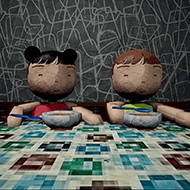
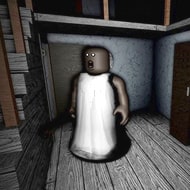
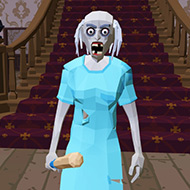
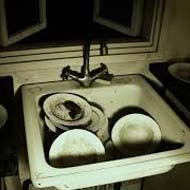
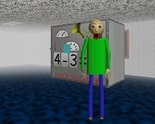
You close the fridge, and it’s empty except for a single plate someone forgot to wash. That small, ordinary detail is where Family Secrets 1: Empty Plate starts pulling the floor out from under you. Made by BADCAT GAMES and built with a soft claymation art style that feels almost cozy at first glance, this short first-person horror game turns a babysitting night into a slow, uncomfortable descent into fear, guilt, and things a child should never have to deal with alone. If you’ve seen clips of it floating around TikTok and Twitch — the hide-and-seek scene, the quiet reveal near the end — this is the full picture of what that game actually is and how it plays.
Family Secrets 1: Empty Plate opens on something almost boringly normal: Miko gets a call from his mother, who tells him she has to leave for work for a few days. No explanation beyond that, no real goodbye scene, just an adult voice on the other end of a phone giving a kid a responsibility he didn’t ask for. From that moment, Miko is in charge of Jun, and the house — usually just a house — becomes the only stage the whole story plays out on.
There’s no map to unlock, no town to explore, no second location waiting behind a loading screen. Family Secrets 1: Empty Plate keeps everything inside four walls on purpose. That choice is part of why it works. Family life doesn’t need a bigger stage to become frightening; it just needs one room to feel wrong at the right moment, and this game leans into that hard.
What makes the setup land is how ordinary it sounds at first. A parent working late, an older sibling watching the younger one, dinner that needs to happen somehow — none of it screams horror. Family Secrets 1: Empty Plate doesn’t announce its genre with a cold open or a jump scare in the first minute. It waits, and that patience is exactly why the eventual shift in tone catches so many first-time players off guard.
Movement, objects, and a flashlight that actually matters
Mechanically, Family Secrets 1: Empty Plate stays deliberately simple. There’s no combat, no health bar, no inventory grid to manage, and no upgrade tree sitting behind a menu. You walk, you look, you interact with what the room lets you interact with, and you move the story forward one triggered event at a time. Players coming in expecting a survival-horror loadout will be surprised at how stripped-down the toolkit is — and that’s the point.
The flashlight is the one mechanic that does real work here. Several rooms in the house are dim enough that you’ll miss small but important details without switching it on, and a few of the game’s better scares depend entirely on what the beam does or doesn’t reveal as you sweep it across a hallway or a corner of Jun’s room. It’s not a resource you manage, like batteries in older horror titles — it’s just there, waiting to be used, which puts the responsibility on the player to actually look instead of rushing through.
Controls for Family Secrets 1: Empty Plate
WASD Move through the house
Mouse Look around and aim your view
E Interact with objects, advance or skip dialogue
F Toggle the flashlight on and off
ESC Pause or resume the game
Because the control scheme is so lean, there’s genuinely nothing to relearn if you’ve played any first-person indie horror game before. That’s a deliberate design decision, and it means the friction between you and the story is almost zero — which, again, is the point. The less you’re thinking about mechanics, the more room the game has to get inside your head.
Miko, Jun, and the weight of being the responsible one
Miko is never given a heroic framing. He’s not a trained investigator or a chosen protagonist — he’s a kid who got handed a task too big for him, and the game never lets you forget that. Jun, meanwhile, isn’t a puzzle to solve or an escort mission to babysit through a checklist. The relationship between the two siblings is the actual emotional spine of Family Secrets 1: Empty Plate, and most of the discomfort in the back half comes from watching that relationship strain under pressure neither character created.
Players who go in expecting a straightforward monster-in-the-house story tend to be the most affected by the tonal turn, because Family Secrets 1: Empty Plate isn’t really about a monster. It’s about neglect, about a house that’s too quiet in the wrong way, and about a child noticing that something in his own family is broken before he has the words to describe it. It earns comparisons to games like the Bad Parenting series for a reason, though its pacing and claymation presentation give it a distinct identity rather than feeling like a copy.
Early in the game, everything reads as a fairly normal evening — checking the fridge, moving between rooms, listening for Jun. By the time you’re deep into the second half of the house, small object placements and background sounds start meaning something different than they did ten minutes earlier, and that recontextualization is where most players say the game actually gets to them.
Advice from someone who’s already been through the house
Don’t rush past the kitchen early on. The empty plate itself and a couple of small details near it set up context you’ll want later, even though nothing about that scene looks urgent at the time.
Keep the flashlight on in any room that feels darker than it should, even if nothing seems to be happening. A few of the game’s best moments are visual rather than audio cues, and you’ll miss them staring at an unlit corner.
Play with headphones. Family Secrets 1: Empty Plate relies a lot on ambient house sounds — footsteps, doors, Jun’s voice from another room — and a lot of the tension gets lost through laptop speakers.
Don’t skip through dialogue with Jun just to speed things along. The writing is doing more character work in those small exchanges than it looks like on a first pass, and it pays off once the story shifts.
If a cutscene or piece of text seems to freeze, give it a second before restarting — a handful of players have run into this bug, and it usually resolves itself rather than needing a full reload.
No levels, no chapters — just one story that keeps going
Family Secrets 1: Empty Plate doesn’t use a level select, a chapter list, or any kind of score screen between sections. It’s structured as one continuous playthrough, with the story moving forward as you trigger events by exploring and interacting rather than by clearing objectives. The listed runtime sits around 30 to 40 minutes for a full playthrough, which puts it firmly in short-horror territory rather than a multi-hour campaign.
That compact length is a feature, not a shortcoming. Family Secrets 1: Empty Plate is built around one situation, one house, and one emotional arc, and it doesn’t pad that out with side content or filler rooms just to extend playtime. Speedrunners and first-time streamers alike tend to land in roughly the same window, since there isn’t much room for detours once the story starts moving.
There’s a free demo available separately from the full release, and a fair number of players mention starting there before realizing the demo cuts off well before the story’s actual turn — worth knowing going in if you want the complete arc in one sitting rather than two separate downloads.
What the community actually talks about
Reception around Family Secrets 1: Empty Plate has been unusually warm for a short indie horror release, and a lot of the praise circles back to the same handful of things: the claymation visual style, the sibling dynamic between Miko and Jun, and how the game handles a genuinely sensitive subject — family neglect — without turning it into shock value for its own sake. Streamers and casual players both tend to describe the ending as sadder than expected rather than purely scary, which seems to be intentional rather than a tonal misstep.
It’s not without criticism. Some players have pointed out that the pacing in the middle stretch of the house can feel a little repetitive, with similar room-to-room beats before the tension escalates again. It’s a fair point, and worth setting expectations around if you’re going in expecting nonstop scares rather than a slower build. A small number of players have also reported text or cutscene freezes that require a restart, which the developer appears to be aware of given how often it comes up in community discussion.
Newcomers who found the game through short clips online — the hide-and-seek reveal in particular has circulated a lot — often say the full context changes how that moment lands compared to seeing it out of order in a fifteen-second video. That’s generally true of Family Secrets 1: Empty Plate as a whole: individual scenes work fine as clips, but the accumulated weight of the house is really the thing worth experiencing firsthand.
Common questions before you start
Is Family Secrets 1: Empty Plate part of a series, and do I need to play anything else first?
The “1” in the title signals it’s intended as the start of a planned series, but there’s no prior installment you need to play beforehand. It stands on its own as a complete short story about Miko and Jun, and any future entries would presumably build on this one rather than require it as a prerequisite.
How long does it take to finish, and is there replay value?
A full playthrough runs about 30 to 40 minutes. There isn’t a branching story or multiple endings to chase, so replay value comes mainly from revisiting specific scenes, checking for details you missed the first time, or introducing a friend to the story rather than uncovering alternate outcomes.
Does the game involve jump scares, or is it more of a slow-burn horror experience?
It’s both, though weighted toward the slow-burn side. Family Secrets 1: Empty Plate uses jump scares sparingly rather than relying on them as the main source of tension, and several players specifically note wishing there were a couple more, since the majority of the fear comes from atmosphere, sound design, and the emotional weight of the Miko-and-Jun storyline rather than sudden shocks.
Family Secrets 1: Empty Plate isn’t trying to be a long game, and it’s better for not pretending otherwise. It takes one ordinary evening, one house, and two siblings — Miko and Jun — and lets a single empty plate on a kitchen counter carry more weight than most horror games manage with an entire cast of monsters. If you’re looking for something you can finish in one sitting and still think about afterward, this is worth the half hour it asks for.
Arjun Patel
Arjun Patel is a freelance writer specializing in indie horror games and narrative-driven interactive media. He writes about psychological horror, game design, and the communities that form around memorable gaming experiences.
Our site uses cookies to personalize and customize ads. You can change your settings and disable unnecessary cookies at any time you want.